Introduction to the Midnight Abyss
Plunging past 1,000 meters (3,280 feet) and descending to a depth of 4,000 meters (13,123 feet), the bathypelagic zone—universally characterized as the “midnight zone”—constitutes one of the most immense, contiguous biological habitats on Earth. In this profound realm, sunlight is entirely extinguished; not a single photon of solar origin penetrates the water column. The bathypelagic volume encompasses over 70 percent of the open ocean’s liquid expanse, enveloped in permanent, total darkness punctuated solely by point-source flashes of organismal bioluminescence.
The physical conditions characterizing the bathypelagic realm are defined by relentless extremes. Seawater temperature remains rigidly uniform across the globe, stabilized between 1°C and 4°C by polar-derived deep ocean water masses. Hydrostatic pressure increases linearly by approximately 0.1 megapascal (one atmosphere) for every ten meters of depth, escalating from 100 atmospheres (10 MPa or 1,470 psi) at 1,000 meters to an overwhelming 400 atmospheres (40 MPa or 5,880 psi) at the 4,000-meter lower boundary. At these colossal pressures, ordinary cellular membranes solidify into waxy, non-functional gel states, delicate enzymatic active sites undergo volume-collapse denaturation, and gas-filled spaces are compressed into non-buoyant voids.
Compounding these physiological hurdles is severe nutritional scarcity. Separated from the sunlit surface by miles of water, the bathypelagic zone relies exclusively upon energy drifting downward from the epipelagic layer above. Only an estimated one to two percent of surface primary production survives the gauntlet of mesopelagic consumption to reach bathypelagic depths in the form of refractory marine snow, decaying organic aggregate flakes, and episodic megafaunal food falls. Survival in this immense cold desert demands radical morphological reductions, metabolic conservation strategies, and astonishing biochemical innovations.
Piezolytic Chemistry and Hydrostatic Adaptations
How do bathypelagic teleosts, squids, and crustaceans thrive under pressures capable of crushing steel hulls? The answer lies in molecular **piezolytic chemistry**—the evolution of pressure-counteracting solutes and structural protein adaptations that maintain enzyme catalysis under extreme compression.
High hydrostatic pressure inhibits enzymatic reactions that involve an increase in system volume (positive \(\Delta V^\ddagger\)). Furthermore, pressure forces water molecules into tight hydration shells around hydrophobic protein clefts, distorting tertiary protein conformation. Deep-sea fauna counter this disruption by synthesizing extraordinary cellular concentrations of the small organic osmolyte **trimethylamine N-oxide (TMAO)**:
TMAO acts as a potent molecular chaperone. By organizing surrounding water molecules into structured hydrogen-bonding networks, TMAO excludes water from entering the internal cavities of proteins, effectively counteracting pressure-induced protein unfolding and restoring standard catalytic velocity to essential metabolic enzymes (such as lactate dehydrogenase and myosin ATPase). Seminal research by oceanographer Paul Yancey revealed a rigorous linear correlation between muscle TMAO concentration and bathymetric habitat depth across marine vertebrates, demonstrating that TMAO synthesis is an obligate biochemical prerequisite for deep bathypelagic existence.
Simultaneously, bathypelagic organisms exhibit **homeoviscous adaptation** within their lipid bilayers. Phospholipids from deep-sea cell membranes possess high ratios of polyunsaturated fatty acids with cis-double bonds that induce structural kinks, preventing the hydrocarbon chains from packing into immobilized crystalline arrays under cold hydrostatic pressure and ensuring the unimpeded operation of membrane-bound ion pumps.
Metabolic Minimization and Morphological Reductions
In a realm where a predator may encounter a meal only once every several weeks or months, energy conservation is the supreme law of survival. Bathypelagic organisms exhibit the lowest mass-specific metabolic rates recorded in the animal kingdom, often an order of magnitude lower than those of shallow-water relatives at equivalent temperatures:
- Skeletal and Muscular Reduction: Bony tissues and heavy structural muscles require substantial metabolic maintenance. Bathypelagic predators—such as anglerfishes (Ceratiidae), gulper eels (*Eurypharynx pelecanoides*), and black swallowers (*Chiasmodon niger*)—have evolved extremely reduced, unmineralized, cartilaginous skeletons and watery, gelatinous musculature with high water content (often exceeding 90% body mass).
- Loss of Hydrodynamic Streamlining: High-speed cruising adaptations (fusiform profiles, rigid keels) are discarded in favor of sit-and-wait ambush predation. Bathypelagic organisms float weightlessly in neutral buoyancy, expending virtually zero metabolic energy until prey drifts within immediate striking range.
- Abandonment of Swimbladders: Maintaining a gas-filled swimbladder against 300 atmospheres of external pressure requires energetic gas-gland pumping against extreme chemical diffusion gradients. Most bathypelagic teleosts have entirely eliminated gas bladders, substituting light, watery tissues and lipid deposits to achieve hydrostatic neutral buoyancy.
| Bathypelagic Species | Common Name | Primary Morphological Adaptation | Trophic Strategy | Depth Distribution |
|---|---|---|---|---|
| Melanocetus johnsonii | Humpback Anglerfish | Bioluminescent esca lure, expandable stomach | Ambush lure predator | 1,000 m – 3,500 m |
| Eurypharynx pelecanoides | Gulper Eel (Pelican Eel) | Massively distensible jaws, pouch-like pharynx | Opportunistic macro-engulfer | 1,200 m – 3,000 m |
| Vampyroteuthis infernalis | Vampire Squid | Filiform retractile sensory filaments, mucilage feeding | Marine snow & detritivore | 1,000 m – 3,000 m |
| Chiasmodon niger | Black Swallower | Highly elastic stomach capable of swallowing prey 2x its size | Active macro-predator | 1,000 m – 3,000 m |
| Bathypterois grallator | Tripod Spiderfish | Elongated pelvic & caudal fin rays for perching | Benthic-boundary current filter | 1,000 m – 4,700 m |
Ceratioid Anglerfishes: Symbiotic Escas and Extreme Sexual Parasitism
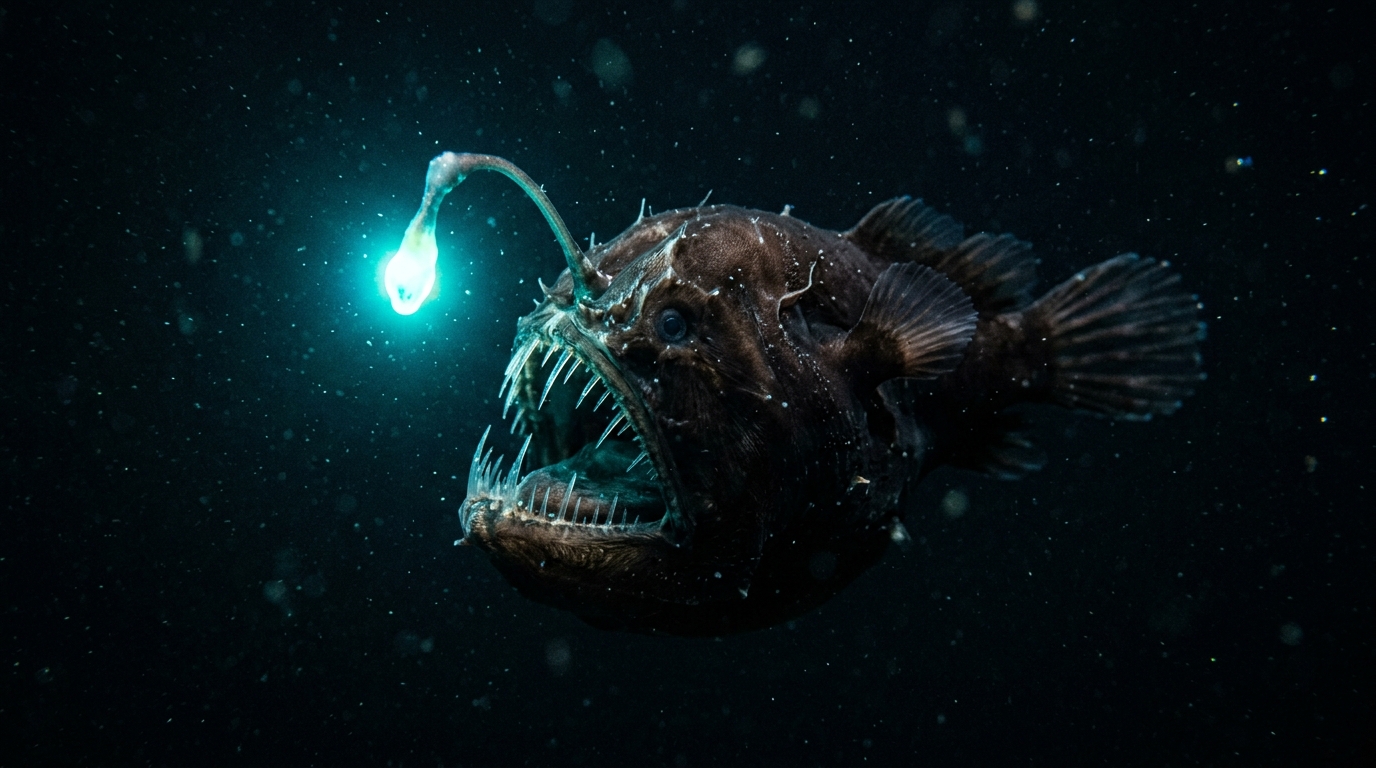
Perhaps no group exemplifies the evolutionary extremes of the midnight zone more vividly than the deep-sea anglerfishes of the suborder **Ceratioidei**. Possessing rotund, unstreamlined bodies and pitch-black pigmentation that absorbs bioluminescent light, female ceratioids evolved the anterior dorsal fin ray into a modified, flexible fishing rod (the **illicium**) tipped with a glowing lure known as the **esca**.
The esca produces brilliant blue-green luminescence through an obligate mutualistic symbiosis with specific, luminous marine bacteria (*Aliivibrio* and *Photobacterium* relatives). The female anglerfish provides a sheltered glandular micro-environment rich in nutrients, while the bacterial culture provides uninterrupted bioluminescence. Anglerfishes manipulate the illicium, twitching the glowing esca directly before their cavernous mouths to entice curious squids, crustaceans, and fishes. When prey approaches, the anglerfish expands its buccal cavity in milliseconds, generating massive suction that engulfs the victim into jaws armed with backward-curving, depressible teeth.
Even more astonishing is the reproductive strategy of dwarf ceratioid males. In the vast, sparsely populated midnight zone, finding a mate is a daunting challenge. Free-swimming males are dwarf miniatures (often less than one-tenth the female’s length) equipped with hypertrophied olfactory organs and specialized eyes tuned to trace the specific pheromone plume and bioluminescent flash signature of a female.
Upon locating a female, the male bites into her ventral tissue. In advanced ceratioid families (such as Ceratiidae and Linophrynidae), this bite triggers permanent physiological fusion: the male’s lips and oral tissues dissolve into the female’s epidermal and vascular systems. Their circulatory systems unite, and the male degenerates into a permanent, nutrient-nourished, sperm-producing testicular appendage. Recent immunological research demonstrated that ceratioids undergoing sexual parasitism have completely lost essential major histocompatibility complex (MHC) immune genes and T-cell receptor pathways, preventing the female’s immune system from rejecting the male as a foreign graft—an evolutionary sacrifice of vertebrate adaptive immunity to ensure reproductive success in the abyss.
Scavenger Guilds and Ephemeral Food Falls
While predatory ambushers wait patiently in midwater, the benthic interface of the bathypelagic zone supports an extraordinarily specialized guild of mobile scavengers. These organisms depend upon episodic, high-energy biological windfalls known as **food falls**—the carcasses of large pelagic animals, including baleen whales (whale falls), large sharks, and giant pelagic fishes that sink rapidly through the water column after death.
A single 40-ton whale carcass deposits centuries of organic carbon and lipid nutrients onto a small patch of deep seafloor. Within hours of landing on the sediment, chemical plumes released into deep bottom currents attract primary necrophagous scavengers from miles around:
- Giant Amphipods (*Eurythenes gryllus*): Highly mobile scavengers equipped with powerful chewing mouthparts capable of stripping soft tissue from bone at astonishing rates.
- Hagfishes (Myxinidae): Jawless, slime-producing cyclostomes that burrow directly into necrotic muscle tissue, utilizing keratinized dental plates to rasp flesh from within.
- Sleeper Sharks (Somniosidae): Massive, slow-moving deep-sea sharks (*Somniosus* spp.) possessing rows of serrated teeth tailored to slicing massive chunks of blubber and muscle from fallen megafauna.
Once the soft flesh is consumed (the mobile scavenger phase, lasting months to a few years), the whale fall transitions into the opportunistic enrichment phase, followed by the **sulfophilic phase**, which can endure for a century. Anaerobic bacteria break down lipids stored within the porous whale bones, reducing sulfate into hydrogen sulfide. This continuous sulfide flux sustains chemosynthetic bacterial mats, which in turn support specialized clams, mussels, limpets, and bone-eating *Osedax* polychaete worms whose root-like collagenase-secreting vascular tissues bore directly into the mineralized matrix of the whale skeleton.
Vulnerability to Anthropogenic Disruption
Although isolated from terrestrial view, the bathypelagic zone is deeply connected to human industrial activities. Microplastics and synthetic chemical pollutants (such as polychlorinated biphenyls and per- and polyfluoroalkyl substances) adhere to sinking marine snow, accumulating in significant concentrations within deep-sea amphipods and benthic detritivores. Deep-water exploratory drilling for hydrocarbons poses severe contamination risks to slow-growing, low-resilience deep benthic communities.
Furthermore, deep-sea organisms exhibit extreme longevity, slow sexual maturation, and exceptionally low reproductive fecundity. Teleost species such as the orange roughy (*Hoplostethus atlanticus*) can live over 140 years and do not attain reproductive maturity until twenty to thirty years of age. Industrial deep-sea bottom trawling along continental slopes and seamounts has decimated ancient cold-water coral gardens and depleted bathypelagic populations, leaving ecological scars that will require centuries to heal. Preserving the integrity of the midnight ocean requires strict enforcement of deep-sea fishing moratoria and comprehensive international legal protection for high-seas marine biodiversity.
The Sensory Void: Non-Visual Mechanoreception and Lateral Line Mapping
In the absolute optical midnight of the bathypelagic zone, ordinary visual systems encounter severe thermodynamic limits. Eyes require substantial metabolic energy to maintain retinal photoreceptor dark currents and synthesize rhodopsin pigments. Consequently, many true bathypelagic fishes—such as whalefishes (Cetomimidae) and tripod fishes (Ipnopidae)—have completely degenerated their eyes into tiny vestigial pins or flattened dorsal reflective plates.
To navigate, coordinate with conspecifics, and strike prey in the dark, bathypelagic fauna rely upon hyper-developed non-visual mechanosensory networks:
- Expanded Cephalic Lateral Line Canals: In whalefishes, the skull is dominated by colossal cavernous mucous channels containing massive neuromast organs. These open pore systems detect minute displacement waves (sub-millimeter water movements) generated by approaching zooplankton or competitors across distances of several body lengths.
- Elongated Fin-Ray Sensors (Tripod Fish): The tripod spiderfish (*Bathypterois grallator*) perches atop the soft bathypelagic sediment using elongated, stiffened pelvic and caudal fin rays measuring over one meter in length. Facing directly into the sluggish benthic boundary current, it raises its pectoral fins upward over its head like sensory antennae, detecting hydrodynamic vortices cast by drifting benthopelagic copepods and snapping them up with precision.
- Tactile Olfactory Barbel Arrays: Stomiiform dragonfishes and deep-sea cusk-eels (*Ophidiidae*) possess elongated chin barbels lined with chemosensory buds and tactile papillae, sweeping the sediment-water interface to locate buried polychaete worms and bivalves.
Trophic Energetics: Lipid Storage and Neutral Buoyancy Physics
At hydrostatic pressures exceeding 200 atmospheres, maintaining neutral buoyancy via gas-filled swimbladders becomes thermodynamically prohibitive. Boyle’s law dictates that as pressure increases, gas volume decreases inversely; pumping oxygen or nitrogen into a swimbladder against several hundred atmospheres of internal tissue pressure requires massive energetic expenditure by the gas gland.
Bathypelagic teleosts and squids solved this fundamental physical challenge through static biochemical buoyancy:
- Low-Density Lipid Deposition: Instead of gas, deep-sea fishes fill their tissues, livers, and skeletal bones with low-density lipids—predominantly wax esters, triacylglycerols, and squalene (specific gravity ≈ 0.86 to 0.92 g/cm³). Because lipids are virtually incompressible liquids, their buoyancy remains constant regardless of depth, allowing bathypelagic fishes to ascend and descend vertical strata without energetic gas-pumping adjustments.
- Ammonium Chloride Replacement in Cranchid Squids: Glass squids of the family Cranchiidae utilize a massive coelomic cavity filled with an isosmotic ammonium chloride (NH4Cl) solution. By replacing heavy sulfate and divalent metal ions with light ammonium ions (specific gravity ≈ 1.01 g/cm³), the squid achieves perfect neutral buoyancy in seawater without accumulating dense lipids or maintaining gas bladders.
Through these static buoyancy mechanisms, bathypelagic organisms achieve perpetual, effortless suspension within the midnight water column, reducing their basal metabolic maintenance energy to absolute biological minimums.