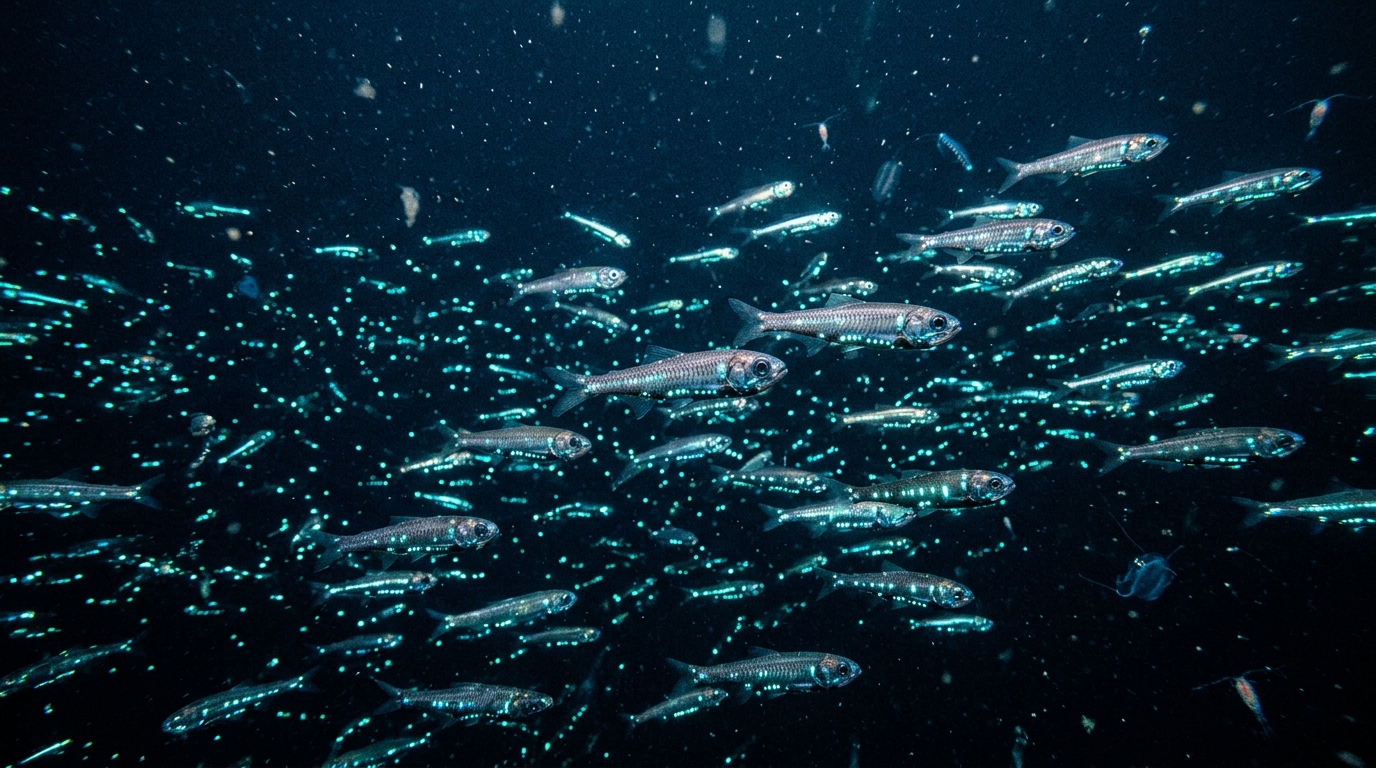
Introduction to the Twilight Realm
Descending beneath the sunlit epipelagic surface, the oceanic water column transitions into the mesopelagic zone—famously designated as the “twilight zone.” Spanning depths from 200 meters (656 feet) down to 1,000 meters (3,280 feet), the mesopelagic realm represents a liminal boundary between the vibrant, sun-drenched surface waters and the perpetual midnight of the deep ocean abyss. Within this vast, shadowy volume, sunlight diminishes rapidly from a dim, directional blue radiance at its upper margins to complete, absolute visual darkness at one kilometer depth.
Despite the absence of sufficient irradiance to support photosynthesis, the mesopelagic zone harbors an astounding concentration of marine life. Recent acoustic surveys and specialized trawling expeditions estimate that the global mesopelagic fish biomass alone ranges between 10 and 15 billion metric tons—a figure substantially larger than the biomass of all commercial fish stocks in the surface ocean combined. The dominant vertebrates of this zone, particularly the lanternfishes (Myctophidae) and bristlemouths (Gonostomatidae), constitute what is widely recognized as the most numerous vertebrate animals on our planet.
The ecological architecture of the twilight zone is shaped by extreme environmental gradients. Temperatures plunge steeply across the permanent thermocline from warm surface values to as low as 4°C at 1,000 meters. Concurrently, hydrostatic pressure increases steadily by one atmosphere (approximately 101.3 kilopascals) for every ten meters of depth, exerting profound physical constraints on cellular membrane fluidity, enzyme kinetic stability, and gas solubility. Furthermore, in many ocean basins, the mesopelagic realm encompasses pronounced Oxygen Minimum Zones (OMZs), where microbial decomposition of sinking surface organic matter severely depletes dissolved oxygen levels down to near-anoxic concentrations.
The Great Diel Vertical Migration (DVM)
Every evening at dusk, the mesopelagic zone becomes the staging ground for the largest animal migration on Earth: the **Diel Vertical Migration (DVM)**. Synchronized with the setting sun, billions of metric tons of mesopelagic organisms—including lanternfishes, hatchetfishes, euphausiid krill, copepods, amphipods, sergestid shrimps, and pelagic squids—embark upon an upward journey spanning hundreds of vertical meters into the nutrient-rich epipelagic zone to feed on surface plankton under the cloak of night.
Before dawn breaks, this colossal biological wave reverses direction, retreating back into the dim sanctuary of the mesopelagic depths before visual predators (such as seabirds, tunas, and billfishes) can detect them in sunlit waters. Historically, this migration was discovered during World War II, when naval sonar operators detected a mysterious, false seabed that ascended at night and descended at dawn. This acoustic phenomenon, termed the **Deep Scattering Layer (DSL)**, is caused primarily by the acoustic resonance of millions of microscopic, gas-filled swimbladders of lanternfishes and the buoyant chitinous carapaces of pelagic crustaceans reflecting sonar pulses.
The ecological and biogeochemical implications of Diel Vertical Migration are profound:
- Active Carbon Export: By feeding on epipelagic phytoplankton and herbivorous zooplankton at night and then metabolizing, respiring, and excreting fecal matter at mesopelagic depths during the day, migrating organisms establish an active “biological escalator.” This active transport bypasses slow passive particulate sinking, injecting dissolved inorganic carbon (DIC) and nutrients directly into the intermediate ocean.
- Metabolic Trade-Offs: Migrators experience radical temperature shifts of up to 15°C across several hours. When residing in the cold, oxygen-poor daytime mesopelagic environment, their metabolic rates drop dramatically, conserving energy and reducing respiratory oxygen demand.
- Trophic Connectivity: DVM provides an indispensable foraging base for intermediate and deep-diving apex predators. Elephant seals, sperm whales, swordfish, and pelagic sharks dive systematically to intercept the Deep Scattering Layer during daytime hours.
Bioluminescence and Photophore Morphology
In the dimly lit mesopelagic zone, vision and light production are inextricably entwined. More than ninety percent of all mesopelagic organisms possess the ability to produce bioluminescence—living light generated through chemical reactions without thermal radiation loss. The chemical reaction universally couples a substrate molecule termed **luciferin** with molecular oxygen, catalyzed by an enzyme termed **luciferase**, or stabilized in a pre-assembled complex known as a **photoprotein**:
In open seawater, the emission spectra of mesopelagic bioluminescence cluster tightly between 460 and 490 nanometers. This blue-green wavelength matches the optical transmission window of seawater, ensuring maximum propagation distance while aligning precisely with the visual sensitivity pigments (rhodopsins) of mesopelagic predators.
Organisms produce light within specialized anatomical organs known as **photophores**. These complex organs feature reflective tapetal backing layers composed of guanine crystal platelets, metabolic shutter mechanisms, chromatographic color filters, and refractive cellular lenses that collimate and focus emitted light beams. In the marine hatchetfish (*Argyropelecus* spp.), tubular ventral photophores project light downward through optical wave-guides, while lanternfishes (*Myctophidae*) exhibit species- and sex-specific arrays of lateral photophores utilized for intraspecific recognition and schooling cohesion in the dark.
| Mesopelagic Species | Bioluminescent Mechanism | Photophore Location | Wavelength Peak | Primary Functional Purpose |
|---|---|---|---|---|
| Myctophum punctatum (Spotted Lanternfish) | Endogenous Luciferin-Luciferase | Ventral & lateral body rows, caudal glands | 470 nm (Blue) | Schooling cohesion, mate identification, counterillumination |
| Argyropelecus hemigymnus (Hatchetfish) | Endogenous Photophore Plates | Ventral abdominal surface | 475 nm (Blue-Green) | Ventral counterillumination camouflage |
| Malacosteus niger (Stoplight Loosejaw) | Endogenous Dual-Color System | Subocular organs (Red & Blue photophores) | 705 nm (Far-Red) & 470 nm | Invisible illumination of prey, private intraspecific communication |
| Histioteuthis bonnellii (Cock-Eyed Squid) | Endogenous Photocytes with Lenses | Asymmetrical ventral mantle & tentacles | 480 nm (Blue-Green) | Counterillumination, disruptive camouflage |
| Bathylagus stilbius (Deep-Sea Smelt) | Symbiotic Photobacterium Phosphoreum | Perianal luminous duct | 490 nm (Greenish-Blue) | Predator distraction, flash illumination |
Counterillumination: The Art of Invisible Silhouettes
In an environment where predators constantly search upward for silhouettes cast against faint downwelling daylight, casting a shadow is a fatal vulnerability. To survive, many mesopelagic fishes, squids, and decapod crustaceans evolved the sophisticated optical defense known as **counterillumination**.
Organisms deploying counterillumination utilize arrays of ventral photophores to emit downward-directed light that precisely matches the intensity, color, and angular distribution of the downwelling sunlight. When viewed from below by an upward-looking predator, the animal’s physical silhouette is optically obliterated; the emitted light blends seamlessly with the ambient downwelling light field. Hatchetfishes and myctophids monitor ambient downward light using upward-directed dorsal receptors or specialized pineal organs, dynamically modulating photophore light output in real time as clouds pass over the surface ocean or as the animal changes vertical depth.
This evolutionary arms race reached astonishing heights in the predatory **Stoplight Loosejaw** (*Malacosteus niger*). While virtually all mesopelagic animals possess eyes sensitive exclusively to blue-green light, *Malacosteus* evolved specialized subocular photophores emitting far-red bioluminescence (peaking at approximately 705 nanometers), coupled with red-sensitive visual pigments derived from modified chlorophyll photosensitizers. Because red light is completely invisible to other twilight organisms, the loosejaw deploys its subocular red photophores as a biological “night-vision sniper rifle,” illuminating unsuspecting prey and communicating with conspecifics without alerting competitors or predators.
Sensory Specializations: Tubular Eyes and Lateral Line Hypertrophy
Capturing scarce photons in the twilight zone requires radical visual engineering. Mesopelagic predators have evolved dramatically enlarged, specialized ocular structures designed to maximize optical aperture and photon capture:
- Tubular Eyes: Fishes such as the spookfish (*Opisthoproctus soleatus*) and hatchetfish possess upward-directed cylindrical tubular eyes. This morphology provides an exceptionally low f-number (high optical speed) and massive binocular visual overlap, granting acute stereoscopic depth perception essential for pinpointing silhouettes of prey swimming directly above.
- Asymmetrical Ocular Architecture: The cock-eyed squid (*Histioteuthis*) exhibits a striking dimorphism: its left eye is vastly enlarged, upward-facing, and tinted yellow to filter out bioluminescent counterillumination and detect downwelling silhouettes, while its right eye remains small, normal, and downward-directed to monitor bioluminescent flashes in the abyss below.
- Hypertrophied Cephalic Lateral Lines: Because visual ranges rarely exceed tens of meters even in the best conditions, mesopelagic teleosts rely heavily upon mechanized non-visual spatial awareness. Deep-sea fishes possess greatly expanded cephalic and trunk lateral line canals packed with sensitive neuromast cells capable of detecting low-frequency water displacements (0.5 to 100 Hz) generated by swimming prey or approaching predators.
Furthermore, extreme hydrostatic pressures alter cell membrane lipid dynamics, packing phospholipid bilayers tightly and hindering protein flexibility. Mesopelagic fauna counter this pressure-induced rigidity by synthesizing extraordinarily high concentrations of polyunsaturated fatty acids (PUFAs), such as docosahexaenoic acid (DHA) and eicosapentaenoic acid (EPA), within their neural membranes, preserving homeoviscous fluidity and synaptic transmission speeds at depth.
Ecological Significance and Emerging Anthropogenic Threats
The mesopelagic zone serves as a linchpin of global planetary biogeochemistry. By regulating the downward flux of particulate organic carbon via the microbial remineralization of sinking marine snow, twilight zone heterotrophs dictate how long anthropogenic carbon remains sequestered from the atmosphere. Oxygen Minimum Zones within the mesopelagic layer are also global hot spots for microbial denitrification and anammox (anaerobic ammonium oxidation), regulating planetary bioavailable nitrogen budgets.
However, this vital twilight realm faces escalating industrial pressures. Commercial fishing interests have repeatedly proposed industrial midwater trawling targeting mesopelagic lanternfish and bristlemouth biomass for conversion into fishmeal and aquaculture feeds. Marine scientists caution that large-scale extraction of mesopelagic fish could destabilize pelagic food webs, deprive open-ocean apex predators of their primary food supply, and disrupt the active biological carbon pump. Simultaneously, climate-driven ocean deoxygenation is expanding Oxygen Minimum Zones, compressing viable mesopelagic habitat and forcing organisms into shallower, higher-risk strata. Establishing robust international marine sanctuaries and deep-sea conservation treaties across areas beyond national jurisdiction (BBNJ) remains critical to safeguarding the fragile twilight ocean.
Oxygen Minimum Zones (OMZs): Physiological Survival in Anoxia
In eastern boundary upwelling regimes—most prominently in the Eastern Tropical North and South Pacific, and the northern Arabian Sea—the mesopelagic zone encompasses profound **Oxygen Minimum Zones (OMZs)**. In these midwater strata, intense surface primary productivity leads to massive downward flux of organic matter. As dense populations of heterotrophic bacteria decompose this sinking organic material, their aerobic respiration consumes dissolved oxygen far faster than physical horizontal advection or turbulent diffusion can replenish it.
Dissolved oxygen concentrations within core OMZs frequently drop below 20 micromoles per kilogram (hypoxia) and can approach suboxic levels under 2 micromoles per kilogram. To survive in these suffocating midwater dead zones, mesopelagic specialists evolved extraordinary respiratory adaptations:
- Hypertrophied Branchial Surface Area: The Humboldt squid (*Dosidicus gigas*) and lanternfishes inhabiting OMZ margins possess greatly enlarged gill surface areas with ultra-thin diffusion distances across branchial lamellae, maximizing oxygen uptake from trace ambient levels.
- Ultra-High Hemocyanin & Hemoglobin Affinity: Mesopelagic squids and fishes synthesize respiratory pigments with exceptionally low P50 values (the partial pressure of oxygen at which pigment is 50% saturated). Blood pigments bind oxygen at partial pressures so low that ordinary fishes would suffer immediate asphyxiation.
- Metabolic Suppression and Anaerobic Glycolysis: Many mesopelagic migrators enter a state of metabolic torpor while residing within the OMZ core during daytime, switching cellular metabolism to specialized anaerobic pathways that minimize energetic consumption until nightfall.
Acoustic Exploration and Modern Biomass Quantifications
Historically, mesopelagic biomass was severely underestimated due to net avoidance: active fishes like lanternfishes and fast-swimming squids easily detect approaching open-ocean trawls via pressure waves and bioluminescent cues, escaping traditional scientific sampling gear.
The breakthrough in twilight zone census occurred with the advent of multi-frequency bioacoustic echosounders during the 2010 Malaspina Circumnavigation Expedition led by oceanographer Carlos Duarte. By calibrating acoustic backscatter signals across 18, 38, 70, 120, and 200 kHz frequencies with targeted optical imaging systems, acoustic models revealed that mesopelagic fish biomass was previously underestimated by a factor of ten.
With an updated global biomass estimate exceeding 10 billion metric tons, mesopelagic fauna represent the vital metabolic engine connecting surface sunlight to the deep abyss. Their respiration and excretion within the twilight zone dictate global ocean oxygen consumption rates, while their acoustic resonance properties continue to provide essential calibration benchmarks for oceanic sonar physics.
Evolutionary Chronology of Mesopelagic Teleost Radiation
Phylogenomic investigations indicate that the radiation of modern mesopelagic teleost lineages—predominantly the Stomiiformes (dragonfishes, bristlemouths, hatchetfishes) and Myctophiformes (lanternfishes)—occurred during the late Cretaceous and early Paleogene epochs, roughly 65 to 50 million years ago. Following the Cretaceous-Paleogene (K-Pg) mass extinction event, the reorganization of ocean circulation and the expansion of oceanic intermediate water masses created massive, vacant midwater niches.
These ancestral teleosts rapidly diversified their sensory and metabolic toolkits, evolving miniaturized body sizes, reduced ossification, and specialized photophore configurations tailored to low-light foraging. Today, myctophids comprise over 250 recognized species distributed across all ocean basins, representing an extraordinary testament to evolutionary radiation within Earth’s intermediate water column.